
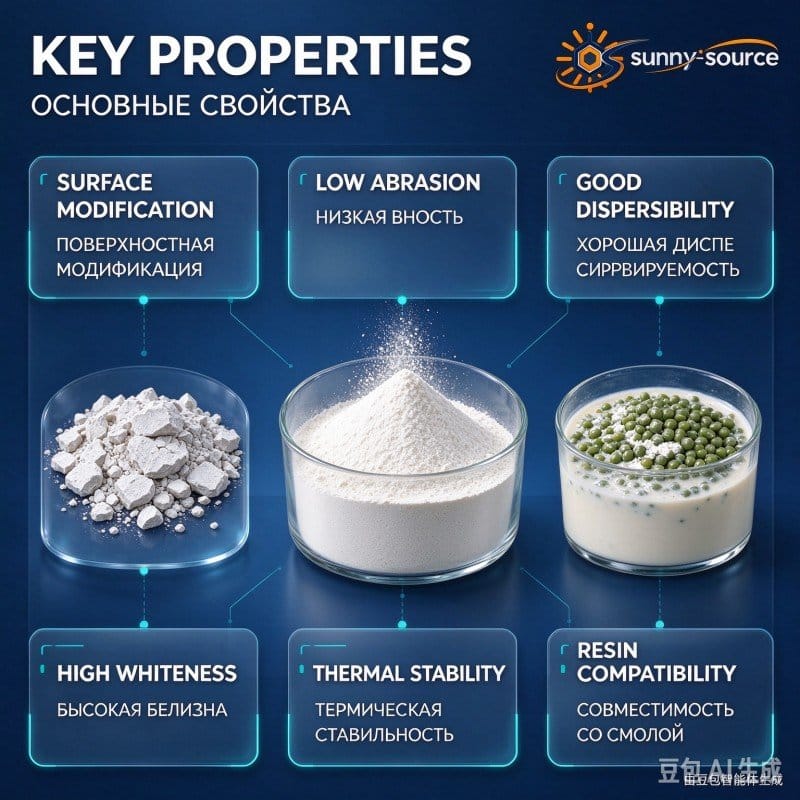
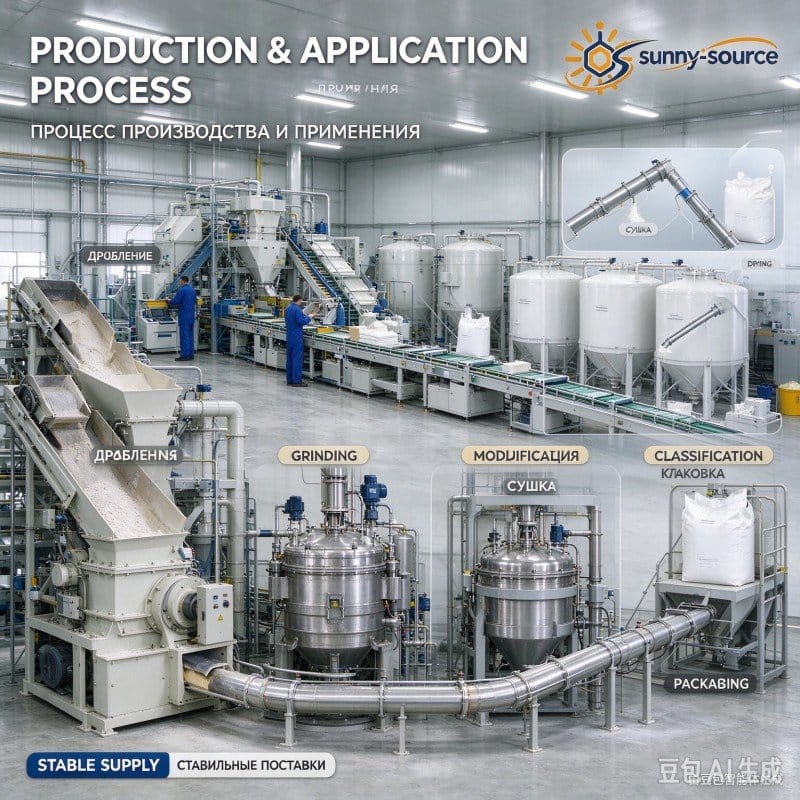
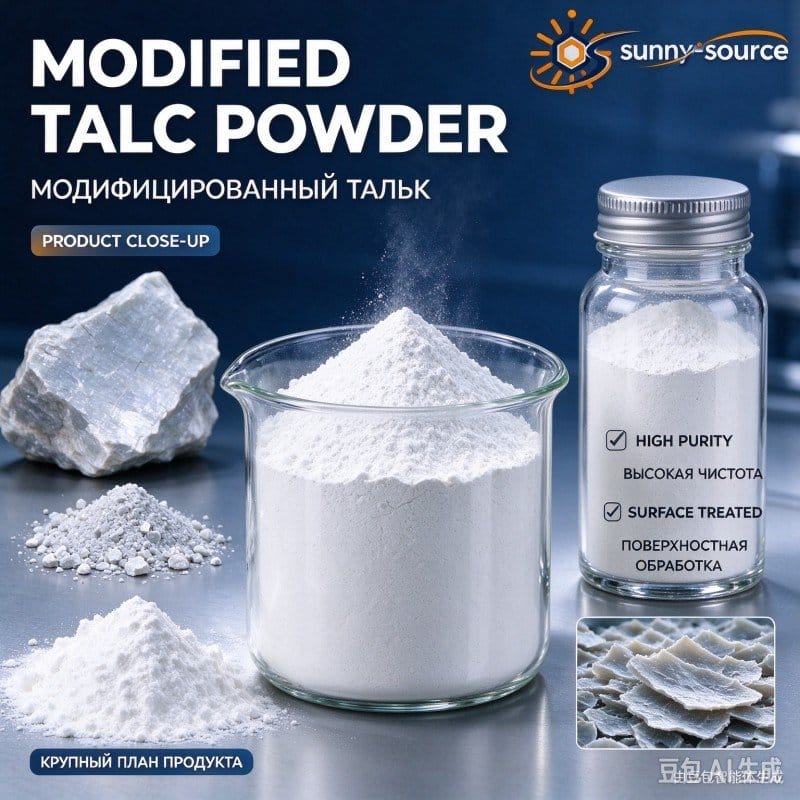


Modified Talc Powder is a high-performance industrial filler produced from high-quality talc ore through fine grinding, classification and surface modification treatment. The surface treatment improves compatibility with resins, polymers, coatings and rubber matrices, making it more dispersible and stable than ordinary talc powder.
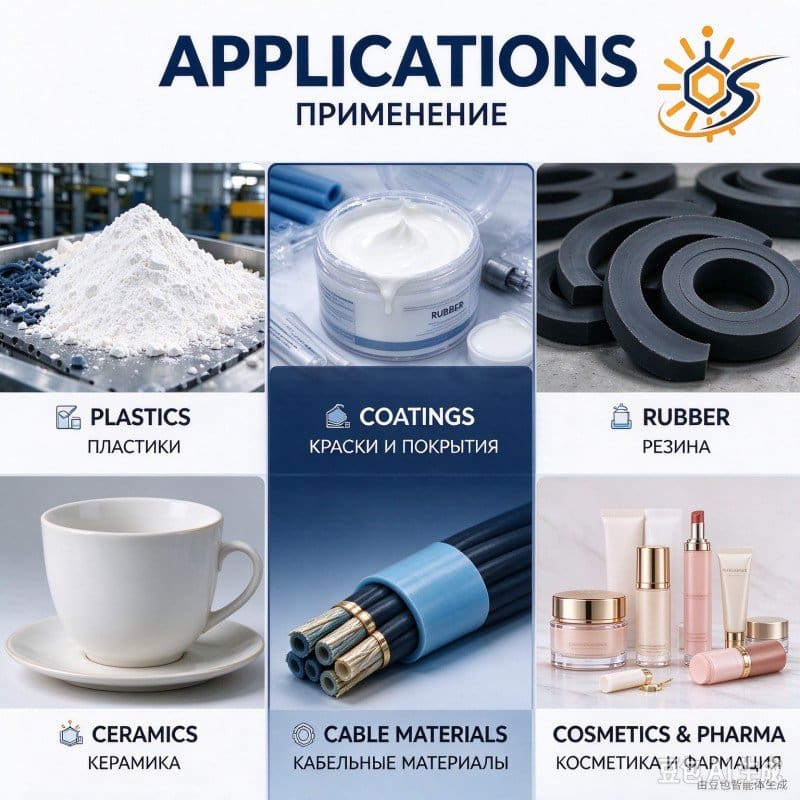
This product features high whiteness, low abrasion, good lubricity, excellent thermal stability and strong covering power. It can be used as functional filler to improve stiffness, dimensional stability, surface smoothness, impact resistance and processing performance of composite materials. It is widely applied in plastics, coatings, rubber, ceramics, cable materials and cosmetics industries.
Our modified talc powder is produced under strict particle size control and surface coating management. It is available in different grades according to particle size, whiteness, oil absorption, surface treatment agent and application requirement. Each batch is inspected for whiteness, particle size, oil absorption, pH value, abrasion and dispersion performance before shipment.
We provide complete export documents including COA, TDS and SDS for quality traceability and customs compliance. Our technical team can recommend the most suitable grade and dosage according to your material system, production process and destination country regulations.
| Product Name | Modified Talc Powder |
| Product Type | Surface-treated industrial talc filler |
| HS Code | 3824.9999 |
| Form | Powder |
| Appearance | White to off-white fine powder |
| Whiteness | 85% – 95% (grade dependent) |
| MgO | 25% – 32% |
| SiO₂ | 55% – 65% |
| Fe₂O₃ | ≤1.0% (low iron grade available) |
| Particle Size D50 | 0.5 – 10 μm (customizable) |
| Oil Absorption | 20 – 50 g/100 g (grade dependent) |
| pH Value (10% suspension) | 7.0 – 9.5 |
| Surface Treatment | Silane / titanate / stearate (customizable) |
| Shelf Stability | 24 months sealed in dry condition |
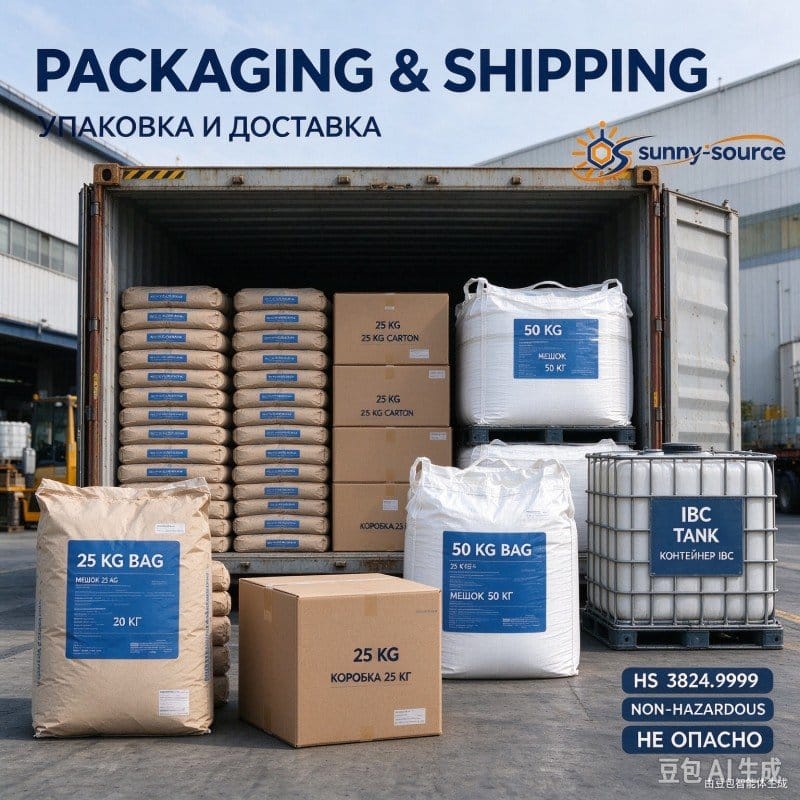
| UN Classification | Not regulated, non-hazardous goods |
| Compliance | REACH compliant, suitable for industrial applications |
Technical indexes can be customized according to customer application, particle size requirement, whiteness target and production process. Export documents include COA, TDS, SDS, packing list and certificate of origin. All batches are inspected before shipment.
| Application Field | Downstream Products & Process | Key Benefits |
|---|---|---|
| Plastics Industry | PP, PE, PVC, composite profiles, plastic parts | Improves stiffness, dimensional stability and dispersion |
| Coatings & Paints | Architectural coatings, industrial paints, primers | Increases hiding power, smoothness and corrosion resistance |
| Rubber Industry | Rubber hoses, seals, tires, industrial rubber products | Enhances tensile strength and abrasion resistance |
| Ceramics Industry | Ceramic body, glaze, electrical porcelain | Improves whiteness, plasticity and sintering stability |
| Cable Materials | Cable insulation, sheath compound, halogen-free cable material | Improves electrical properties and flame retardant efficiency |
| Cosmetics & Pharma | Body powder, cream, pharmaceutical excipient | High purity, good lubricity and skin feel |
Designed for PP, PE, PVC and composite profiles. Recommended addition: 10%–30%.
Suitable for architectural coatings, industrial paints and primers. Recommended addition: 5%–20%.
For rubber hoses, seals and industrial rubber products. Recommended addition: 15%–35%.
Optimized for ceramic body, glaze and electrical porcelain. Recommended addition: 10%–25%.
For cable insulation, sheath compound and halogen-free cable material. Recommended addition: 10%–40%.
High purity grade for cosmetics and pharmaceutical excipients. Recommended dosage depends on formulation.
Custom grade by particle size, whiteness, oil absorption, surface treatment agent and application requirement. Trial samples and full export documents are available.
POINTS FOR ATTENTION
For new customers, we recommend a small trial batch first to verify modified talc powder performance in your actual production system and pre-review export documents before bulk order.
The recommended dosage varies by application, typically from 5% to 40%. Start from lower dosage and adjust according to formulation test and production result.
Add modified talc powder gradually into the matrix under stirring, extrusion or grinding. Control dispersion time and shear intensity to avoid particle agglomeration.
Before mass production, test compatibility with resins, polymers, pigments, additives and other fillers. Observe viscosity change, dispersion stability and final product performance.
Adjust grade and dosage according to particle size distribution, processing temperature, moisture and final product specification. Fine grades usually require more careful dispersion.
Keep sealed in a dry, cool and ventilated warehouse. Avoid moisture, rain and direct sunlight. It is non-dangerous goods for shipping.
Wear dust mask, gloves and goggles during handling. Avoid inhaling dust. If splashed into eyes, rinse with plenty of clean water immediately.
| Application Type | Main System Components | Recommended Grade |
|---|---|---|
| PP Composite Profile | PP resin, stabilizer, modified talc powder | MT-100 |
| PVC Plastic Part | PVC resin, plasticizer, filler, modified talc powder | MT-100 |
| Architectural Coating | Emulsion, pigment, filler, modified talc powder | MT-200 |
| Rubber Seal | Rubber matrix, carbon black, filler, modified talc powder | MT-300 |
| Ceramic Body | Clay, quartz, feldspar, modified talc powder | MT-400 |
| Cable Insulation Compound | Polymer, flame retardant, filler, modified talc powder | MT-500 |
| Cosmetic Body Powder | Talc, pigment, binder, modified talc powder | MT-600 |
| Custom Formulation | Customer material system and performance target | Custom Modified Talc Powder |
Use MT-100 for plastics, MT-200 for coatings, MT-300 for rubber, MT-400 for ceramics, MT-500 for cable materials and MT-600 for cosmetics/pharma. The dosage should be confirmed by formulation test and final product quality inspection.
FAQ
PRICE INFORMATION
- Quotation Basis: CMC price depends on product grade, viscosity, substitution degree, order quantity and delivery terms.
- Price Validity: All quotations are subject to market raw material fluctuation. Normally valid for 7 days unless otherwise specified.
- Price Contains: The quoted price covers product cost and standard export packaging. Freight, insurance and export charges are calculated separately according to Incoterms.
- Tax & Invoice: Commercial invoice for export will be provided. Relevant export tax formalities can be handled.
- Payment Discount: Better price can be offered for larger repeated orders. Please contact us for the latest formal quotation.
DELIVERY TIME & SHELF LIFE
- Production Lead Time: 7–15 working days after receiving your deposit, subject to factory production schedule.
- Shipping Arrangement: After production completion, we will book container and arrange shipment. Port space availability may affect the departure date.
- Transit Time: Sea transit time varies according to destination port, generally ranges from 15 to 45 days.
- Shelf Life: 24 months from production date when stored under proper dry and cool conditions with original sealed packaging.
- Storage Warning: Once the bag is opened, please consume as soon as possible and keep away from moisture, high temperature and direct sunlight.
PRODUCT QUALITY
- Raw Material Inspection: All raw materials are strictly inspected before entering production line to guarantee stable base quality.
- In-process Monitoring: Continuous online monitoring during production for viscosity, substitution degree and moisture content.
- Batch Test: Every finished batch will be sampled and tested before delivery. Qualified report will be provided together with shipment documents.
- Consistency Control: Automated production lines reduce batch difference, ensuring stable performance for repeated orders.
- Quality Support: We accept third-party inspection before shipment. Technical team offers after-sales technical support for quality related issues.
ABOUT US
- Headquartered in Shijiazhuang: Based in Shijiazhuang, Hebei, a globally influential fine chemical production hub with huge capacity and full industrial chain to ensure stable raw materials and bulk supply.
- Geographic Advantage: Convenient inland transport near Tianjin and Qingdao ports, supporting fast container shipment and competitive export logistics cost.
- Full-chain Supplier: One-stop provider of fine chemical additives and matching production equipment, custom service available beyond cellulose ethers.
- Technical Team: Professional team supplies formula consultation, sample testing and product selection for various industrial projects.
- Global Export: Years of export experience, providing reliable goods, full export documents and timely after-sales technical support.
相关产品及设备
- AIChE https://www.aiche.org/
- IChemE https://www.icheme.org/
- Cheresources https://www.cheresources.com/
- NIST Chemistry WebBook https://webbook.nist.gov/chemistry/
- AspenTech https://www.aspentech.com/
- DECHEMA https://www.dechema.de/en.html
- ChemEngPlanet https://www.chemengplanet.com/
- PubChem https://pubchem.ncbi.nlm.nih.gov/
- Chemical Processing https://www.chemicalprocessing.com/
- ChemIndustry https://www.chemindustry.com/
- PharmaChemEngineer https://www.pharmachemeng.com/
- GlobalSpec https://www.globalspec.com/